
Explainer: How Grand Slam tournament draws are made
A handy guide ahead of tomorrow's Roland Garros draw.

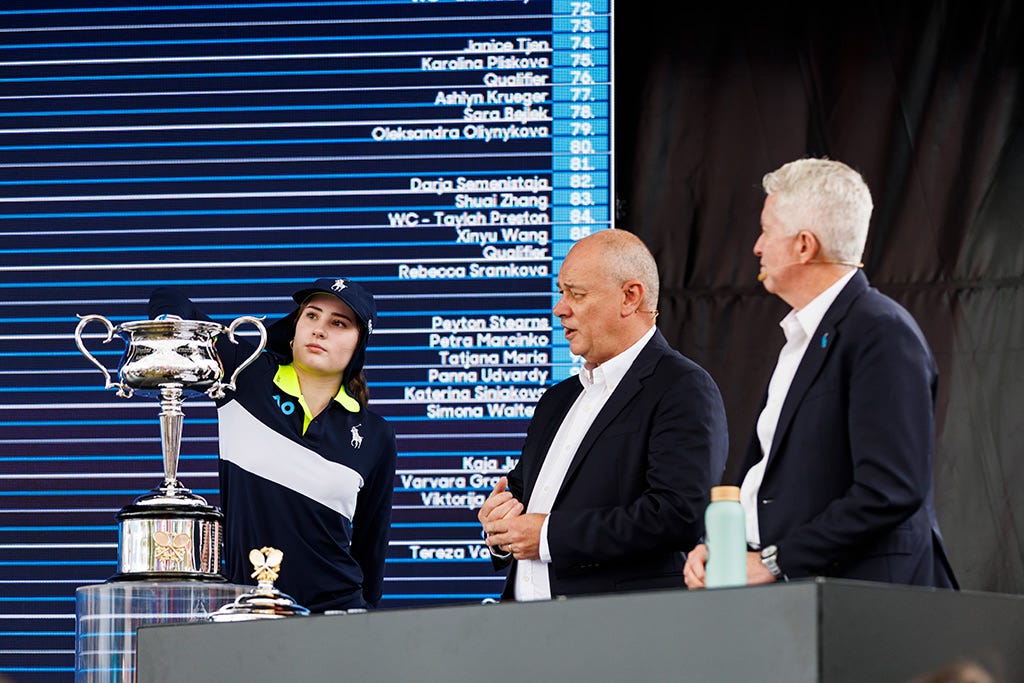
Ahead of January 2025, we published an article on ausopen.com explaining the many steps, across a six-week period, required to assemble a Grand Slam singles draw.
If you missed it then, we’re sharing un updated version of it here, with the Roland Garros draw ceremony just one day away.
Grand Slam draws – showing who plays whom – require many steps to finalise, which are all ticked off over a six-week period leading into the tournament.
Tournament organisers don’t simply take the top-ranked men and women and drop them into brackets. It’s a little more involved than that – and we’re going to take you through it.
What is a draw?
The ATP Tour (the men’s professional tour) website defines a draw as “the knockout tournament bracket that determines the match-ups at an event. It [appears] just like any other tournament, like the knockout stages of football’s World Cup or March Madness in NCAA basketball.”
The draw differs from the order of play, a daily schedule of the matches assigned to each court during a tournament.
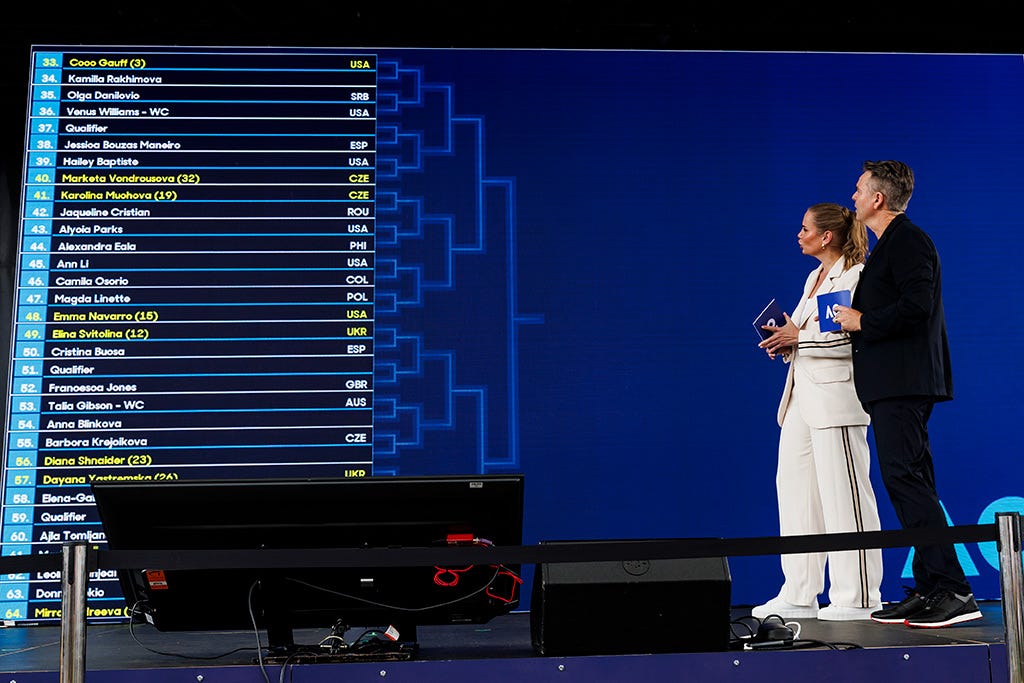
For the draw, player names are placed onto a series of lines; when you look at a tournament draw on paper or on screen, these lines (sort of) resemble a family tree.
Which players get in?
Men’s and women’s singles main draws at Grand Slam events comprise 128 players. Those 128-player fields are made up of:
>104 direct entrants (the highest-ranked players)
>8 wildcards (selected by the tournament organisers)
>16 qualifiers (players who win through the pre-event qualifying competition)
The top 104 players earn direct entry based on their ranking six weeks before the main draw starts. New ranking positions are released each week on a Monday, and with the Roland Garros main draw beginning 24 May, that means players were directly accepted to the 2026 field in the order they appeared in the 13 April rankings.
Fans often express surprise at seeing players, who did not earn direct entry, competing in qualifying with a ranking well inside the top 104.
For example, Alycia Parks led the AO 2025 qualifying entry list, ranked No.82. Yet she was outside the rankings cut-off when the main-draw entry lists were released the week of 2 December 2024.
That same week in December, Parks won a tournament in Angers, France, boosting her ranking from world No.103 to just outside the top 80. That rise was reflected in the next rankings release on 9 December – a week too late for AO 2025 main-draw entry.
Protected/special rankings
But wait a minute: how was Parks not an AO 2025 direct entrant as world No.103, if the top 104 players are accepted?
That’s because the direct entry ranking cut-off for the AO women’s singles event in 2025 was actually No.98, not No.104.
And that’s because six players used ‘special rankings’ to enter.
The men’s tour calls them ‘protected rankings’, but they’re essentially the same thing on both tours, allowing players to freeze their ranking where it was at the beginning of an absence, and use that ranking to enter tournaments when they return.
The women’s tour (WTA) rulebook states that players can apply for a special ranking if they “have an Out-of-Competition Period … [and] submit documentation of a Medical Condition, Compulsory Military Service, Parental Start, or Pregnancy…”
For example, Belinda Bencic was ranked 913th on 2 December 2024, but had been granted a special ranking of No.15, her absence due to pregnancy. She gave birth to daughter Bella in April 2024, missing 13 months in total before her October comeback.
That means that to create the draw for AO 2025, Bencic slotted into position No.16 on the entry list, directly beneath actual world No.15 Jelena Ostapenko.
Five other women used special rankings well inside the cut-off, taking six valuable positions inside the top 104 – and making them unavailable to those players actually ranked No.99-104, including Parks.
What happens if a player withdraws?
In the weeks after the release of the entry lists, some players drop out.
Just 11 days after the official entry lists were published on rolandgarros.com, two-time defending champion Carlos Alcaraz withdrew from the men’s singles, citing a wrist injury. And in subsequent weeks, Jack Draper and Lorenzo Musetti joined him on the sidelines.
This means three new names must replace them on the men’s entry list.
Replacements are taken from the main-draw alternates list. For Roland Garros 2026, the highest-ranked man on that list – the first outside the main-draw cut-off – was Spaniard Daniel Merida, then ranked No.104 and who was elevated to replace Alcaraz. Matteo Arnaldi replaced Draper, and Stan Wawrinka entered in place of Musetti.
Wildcards
After the entry lists are released, the process of awarding wildcards begins.
“[Wildcards are] players who are included in the draw at the sole discretion of the individual Grand Slam Tournament,” explains the 2026 Official Grand Slam Rule Book.
Players don’t need a wildcard if they’re directly accepted. So you can assume any wildcard is not among the world’s top 104 players at the time of entry. Otherwise, their ranking is irrelevant. At AO 2021, Aussie comeback kid Li Tu had no ranking at all when he received a wildcard.
Roland Garros typically awards its eight men’s and eight women’s wildcards like this:
>One to an Australian player, nominated by Tennis Australia
>One to an American player, nominated by the United States Tennis Association
>Six discretionary wildcards


The Australian and American wildcards are a reciprocal arrangement; at the Australian and US Opens, a French man and woman are given main-draw wildcards.
Discretionary wildcards are most often awarded to French players, but sometimes also to a superstar outside the main-draw cutoff; in 2026 that player was three-time Grand Slam champion Stan Wawrinka, playing for the last time at a tournament he won in 2015.
(Interestingly, Wawrinka was ranked just outside the main-draw cutoff on 13 April, at world No.107. With Musetti’s withdrawal, he was elevated into the main draw to replace him, and his wildcard was re-allocated to Frenchman Clément Tabur)
There is no set timeline for when wildcards are announced, except that all eight must be named before the draw is made.
Making the draw
At Roland Garros 2026, the main draw will be made at 2pm in Paris on Thursday 21 May.
This is when the final list of 128 players are placed onto the various lines of the knock-out tournament bracket.
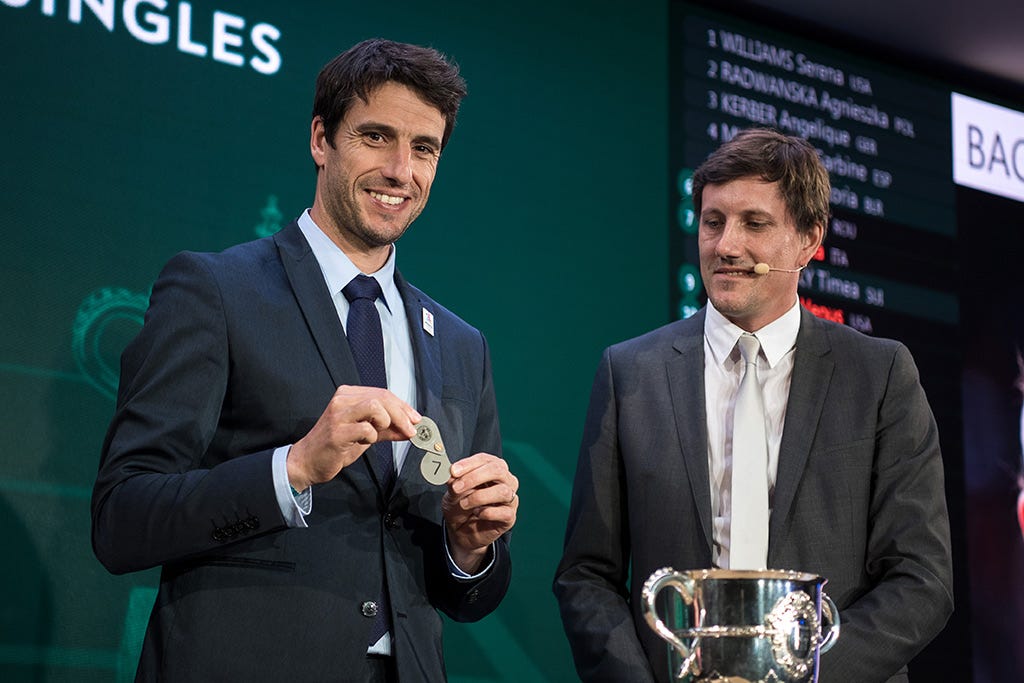
Ninety-six lines are filled by the unseeded direct entrants, the eight wildcards, and the 16 qualifiers – a process completed at random by a computer. Then, the 32 seeds, represented by numbered chips, are drawn from the Roland Garros trophies and placed onto the specific lines remaining.
Placing the qualifiers
Like the main draw, the men’s and women’s qualifying competition features a field of 128 players and entry lists to determine the competitors.
The players on those entry lists fell outside the main-draw entry ranking cut-off, and did not receive a wildcard. The 128-player qualifying fields include 119 direct entrants and nine wildcards.
With 16 going through, players must win three matches (or rounds) in qualifying to secure their place in the main draw. Even so, the successful qualifiers are not always known at the time the main draw is made.
Roland Garros qualifying is scheduled to conclude after the draw ceremony has been completed, meaning placeholder text – “qualifier/lucky loser” – is used on the lines where qualifiers are drawn.
When all 16 qualifiers are known, they’re placed onto those lines to complete the draw.
Lucky losers
All that’s left to do is start playing the matches. Or is it?
There’s every chance the Roland Garros 2026 main draw remains unchanged from the time it’s completed on 21 May, to when first-round matches begin on 24 May.
But in that three-day period, another player could withdraw. And once the qualifying competition has started, the main-draw alternates list cannot be used to fill that gap.
This is where “lucky losers” come in, defined as “those players who have lost in the final round of the qualifying competition…”
The system is complicated – get into the weeds of it on page 31 of the 2026 Official Grand Slam Rule Book – but essentially, of the 16 players who lose in the final round of qualifying, the highest-ranked four are in contention, and one of those four is randomly selected to replace a withdrawn player.
Main-draw withdrawals can occur as late as minutes before the first point of a match is played. This means lucky losers must be on site, signed up, and, according to the Grand Slam Rule Book, “ready to play within five (5) minutes for men’s events and fifteen (15) minutes for women’s events after the announcement of the default.”
On the rare occasion this happens, it’s an excitingly unexpected opportunity for a hopeful who had resigned themselves to not competing.
And it’s led to some phenomenal stories, where players have made an eleventh-hour dash to be on site, ready for a lucky loser call-up.
I finally get it now!!!